Signal Loss: The IDM Labels That Went Quiet and What Comes After 100
Rephlex, Merck, Toytronic, Hefty, Tigerbeat6, Underscan, a small label from the Carolinas, and the giant that outlived them all. A label owner's look at what happened to the imprints that built this culture, and where Clean Error stands now.


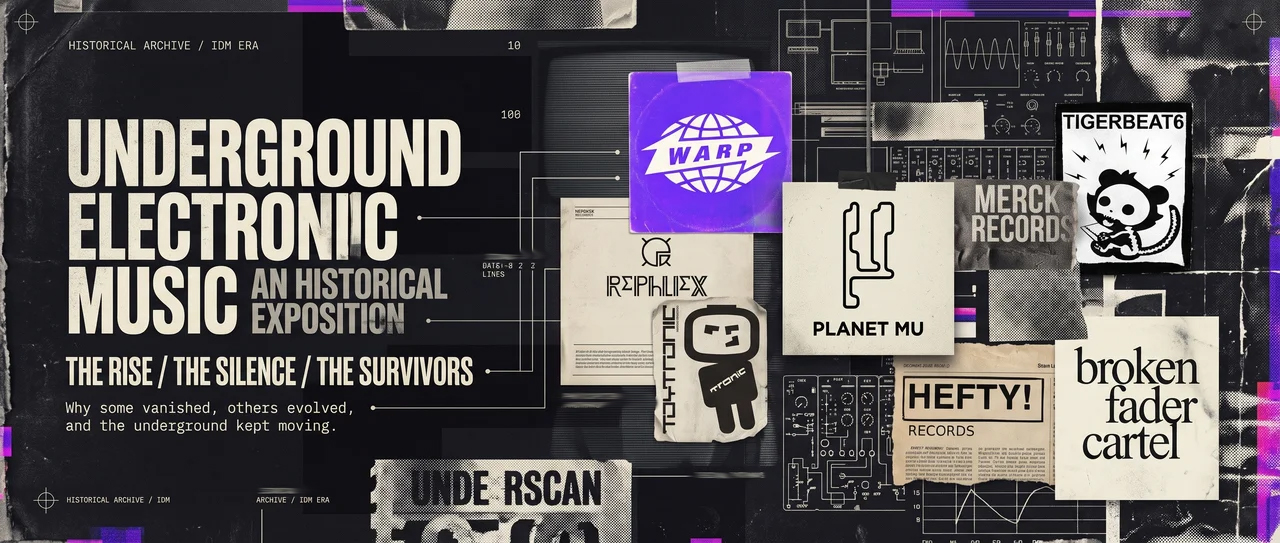
Nine logos. Three still release music.
We just put out our hundredth release. I wrote about ERR100 already, and about what Grier Edward Carson did with the archive. This piece is about the other thing that's been sitting with me since.
With the slow but steady rise of Clean Error Records, a growing roster and releases that show no sign of slowing down, I'm feeling a certain creative fatigue. Not because I've lost my passion for the music or the artists. I'm becoming more aware of the uncertainty surrounding all of it. Looking back at influential IDM labels like Rephlex, Merck, Toytronic and Tigerbeat6, one of my indie favorites, I can't help but recognize a pattern. Labels that once shaped whole underground communities eventually disappeared. Sometimes with an explanation, sometimes without a word. This isn’t an exhaustive list.
These are the labels I’d personally start with, and there are a lot more out there. I might write about them later down the line.
It makes me wonder about the sustainability of what I'm building. How long I can realistically keep nurturing it. What it looks like on the other side. There's something inspiring and unsettling about knowing that even the labels that meant the most to this culture weren't necessarily built to last.
So I did what I usually do when something bothers me. I went digging.
A quick map before we go in
IDM was never only a sound. It was an infrastructure. Mailing lists, record shops, distributors, a few dozen labels with personalities strong enough that you'd buy a record on the logo alone. The term itself spread through the IDM List, a mailing list that started as a place for Aphex Twin and Rephlex fans to find each other. The scene was organized around labels from the start.
Here's how the ones in this piece line up across thirty-seven years.
Start and end years are approximate where the record is thin, especially for Toytronic, Underscan and Broken Fader Cartel.
Rephlex: the label that kept two friends together, until it didn't
Rephlex started because Grant Wilson-Claridge noticed the guy DJing alternate weeks at a club near Newquay was playing tapes of his own music. That guy was Richard D. James. Wilson-Claridge used money he'd inherited to press records, and in 1991 Rephlex existed. The original mission, as the Wax Poetics history tells it, was acid. Innovation in the dynamics of acid, and proof that British dance music could be entirely original.
What it became was bigger. Rephlex put a name, braindance, on music that refused every other category. The big Aphex Twin albums went to Warp. James kept the stranger stuff at home, AFX and Caustic Window, and the catalog filled out with Squarepusher, Drexciya, Cylob and DMX Krew. Pseudonyms everywhere. Records that sounded like jokes until you realized they weren't.
It closed in 2014 after twenty-three years. James said it plainly in a Groove interview: he'd rather be Grant's friend than his business partner, and he admitted the label had kept them together. Orb Mag's retrospective adds a difference of opinion and money trouble in the years before.
The part I keep turning over isn't the ending. The label's survival depended on a friendship, and the friendship depended on not having to run a label. Wilson-Claridge kept going with Perälä on the Colundi project, music tuned to its own custom scale. James kept going on Warp.
Merck: Miami, a hundred records, and a very short goodbye
Merck matters to me for a specific reason. It proved an American label could run with the UK names. Gabe Koch started it in Miami in 2000, and by the time it stopped it had put out 51 CDs and 50 vinyl records. Scroll the roster now and it reads like a list of people who went on to define the next fifteen years. Machinedrum. Tycho. Jimmy Edgar. Helios.


Merck covers as they ran with Igloo's original reviews, 2004 and 2005.
The sound moved from cut-up vocal hip hop to central IDM to indie-tinged electronica, and the label kept artist imagery famously minimal. No push-marketing machine. Look at those sleeves. Flat color, small type, almost nothing to grab onto. You found Merck because someone told you about Merck.
When it ended, the first public statement went to Igloo. Pietro Da Sacco asked Koch why, and Koch gave a deliberately vague answer: dozens of reasons, some business and some personal. He didn't want bad blood and he didn't want to talk about his private life. He handed the Narita sublabel to Adam Johnson and walked.
I respect that answer more now than I would have at twenty. Seven years, at that volume, with physical stock and distributors in the middle of the download era. Anyone who's done it can fill in the list.

Merck's Bandcamp today, still selling the back catalog including Merck Fragments, Ilkae's Bovine Rearrangement and the Aurora comps.
Toytronic: perfumed mailers and the business nobody wanted to run
If you bought IDM in the early 2000s you remember Toytronic's packaging before any single track. The vinyl shipped in a custom die-cut mailer that smelled. Perfumed. Gimmik's Load Error EP was TOY1, and tracks like "Floppy Disk" set the house sound: thudding analog low end, structured glitch on top, a lullaby melody glinting through the middle. And that little robot on the logo, sideways glance and all.
Toytronic built one of the most recognizable melodic IDM identities of its era and stopped around 2009. From what Haidinger has said since, the music wasn't the problem. Everyone loved making records, choosing artists and designing sleeves. Nobody wanted to handle the business, and the admin wore down whoever got stuck with it.
That one stings a little. I know which parts of running Clean Error give me energy and which parts drain it, and they map almost exactly onto what Toytronic described.
The records didn't die. Barcelona's Lapsus has spent years reissuing them with real care: Abfahrt Hinwil's Links Berge Rechts Seen, Ochre's A Midsummer Nice Dream, and Gimmik's Slow Motion Process (20th Anniversary Edition) with artwork updated by Haidinger himself.

Gimmik, "Form2," from the Lapsus reissue of Slow Motion Process.
Hefty: Chicago, a dorm room, and the distributor that vanished overnight
Hefty started in a college dorm room in 1995. John Hughes III, yes, the son of that John Hughes, wanted somewhere to put out his own music as Slicker. It moved to Chicago and turned into something stranger and wider than an IDM label. Post-rock, nu jazz, instrumental hip hop, reissues of the Detroit jazz collective Tribe. Scott Herren came through as Savath & Savalas. Hughes pressed the early Immediate Action records by hand.
Then Telefon Tel Aviv. In a Stop Smiling oral history, Josh Eustis remembers him and Charlie Cooper overnighting a demo to the label and getting a call from Hughes the next day. That demo became Fahrenheit Fair Enough, released on Hefty in September 2001. Glassy, melancholic, the edits so precise they almost read as acoustic. Ghostly reissued it fifteen years later.
Here's the Hefty detail that gets me. In 2006, celebrating ten years, Hughes told the Chicagoist that their US distributor went bankrupt overnight, right after an Eliot Lipp record came out. International distribution was great. At home in the States, they suddenly had nothing. He figured it would keep happening, because distributors were disappearing everywhere.
Good roster, loyal audience, real reputation. One company somewhere else folds and the floor drops out. Hefty's last release came in 2010.
Tigerbeat6: the one that didn't care about being serious
Tigerbeat6 is personal for me. Kid606 started it in 2000 with Kid606 and Friends Vol. 1, and from day one it was a reaction against the seriousness around it. While the rest of IDM built cathedrals out of drum programming, Tigerbeat6 put out distortion, mashups, breakcore, noise and jokes, sometimes on one record. That logo says it better than I can. A skeleton monkey with a laptop and lightning bolts coming off its head. There were sublabels for bootlegs (Violent Turd) and ragga jungle (Shockout).
And then he'd swing the other way. Mille Plateaux, of all labels, put out his gentle P.S. I Love You. Resilience in 2005 went straight back to IDM listening music. He told the East Bay Express he had to start a label because he couldn't physically or mentally just make music. That sentence explains half the label owners I know. Including me.
A Sound On Sound feature framed him as someone who'd watched bedroom electronic music boom and then hit an identity crisis. Tigerbeat6 kept moving through it. Happiness came out on the label in 2013, the Recollected Ambient Works volumes in 2015.
After that the trail thins. No goodbye. No closing statement, no release marked final. The label just stopped being a place things arrived. Most of the music is still for sale. The community around it is what went dark.
That version scares me most. Rephlex closed. Merck closed. Tigerbeat6 faded, with over two hundred releases behind it and an identity anyone in this scene would recognize from that monkey alone.
Underscan: Berlin, ten-inch records, and silence
Underscan is the one I went down a rabbit hole for. I heard a track called "Querverweis" by Menu:Exit and wanted to know who was behind it. Turns out Menu:Exit was Markward Wagner and Ralf Pytlik, and they also ran the label. Musicians releasing their own music next to people they admired. Same model as half the labels in this piece. Same model as Clean Error, honestly.
Look at that logo. A box inside a box, thin lines, lowercase type. Very Berlin, very early 2000s. In 2002 they started a run of limited ten-inch vinyl. The first was Scanner's Lost Without Light, three tracks in an edition of 500, and Igloo reviewed it in January 2003 as the start of that series. Frank Bretschneider came through too. The Now compilations stitched minimal electronics, dub and glitch together across four volumes.
Scanner, Lost Without Light (Underscan, 10", 2002), now on Scanner's own Bandcamp.
Around 2009 the label reportedly went digital-only, with a Now Remix collection. After that I couldn't find anything new. The old site doesn't load. No farewell. The label's name still shows up in German rights registries, which tells you a company exists on paper and nothing about whether anyone's releasing music. Notice where the record survived, though. On the artist's own page, not the label's.
Broken Fader Cartel: one state over
Not every label that mattered had a hundred releases. Broken Fader Cartel came out of Asheville, one state over from where Clean Error lives in Georgia. I knew BFC from the outside, as a listener, before Clean Error existed. It felt enormous to me then. Looking at what's documented now, it was tiny. Both are true.
It was a collective more than a company. Gray Gannaway founded it, Brian Miller managed it, and Alex Polzien was billed as a founding member on a 2006 North Carolina showcase with I Broke My Robot, Nauseous Youth Future and Production Unit Xero. The promo copy called the sound "blips, bloops, glitches & busted loops," which is about the most 2006 sentence ever written. Also accurate. The logo was all serif and no robot, which I always liked. It looked like a literary journal that had wandered into a noise show.
| Release | Type | Year |
|---|---|---|
| the collective polycarbonate release | Compilation, 11 tracks | c. 2005 |
| Nauseous Youth Future, Dosage | Album, 11 tracks | 2005/2006 |
| Cloud Control | Compilation, 15 artists, five countries | 2006/2007 |
| I Broke My Robot, Tomorrow Does Not Exist | Album, BFC 006 | September 2007 |
Cloud Control is the one I find most instructive. A small Asheville label pulled fifteen artists from five countries onto one disc, Scanone and Thiaz Itch among them. Igloo judged it against the whole international netlabel scene, not as a regional curiosity.
Tomorrow Does Not Exist was BFC's sixth release and the one that lasted. Violent, emotionally unstable breakcore programmed with surgical patience. In August 2025, eighteen years on, the NTS Guide to Breakcore played it third, right after two Venetian Snares tracks. I Broke My Robot is still making music out of Lynchburg, Virginia.
I Broke My Robot, "kllswitch" (2017). The BFC-era records survive on streaming services, not on any official label page.
After 2007 there's almost nothing. The domain is gone. No announcement, no breakup interview. The music survived. Who ran it and what the full catalog was now takes detective work to piece together. The records outlived the story.
And Sending Orbs
One more for the quiet pile. Sending Orbs in the Netherlands built a cult catalog around Kettel and Secede, paused around 2010, came back with When Can in 2012, then stopped acting like a label. Lapsus is reissuing that one now too. Lapsus is basically running a hospital for this era at this point.
What actually killed them
| Label | How it ended | What survived |
|---|---|---|
| Rephlex | Founders chose the friendship over the business | Catalog with the artists, Colundi |
| Merck | "Dozens of reasons," business and personal | Label Bandcamp, a generation of artists |
| Toytronic | Admin burnout, nobody wanted the business side | Lapsus and n5MD reissues |
| Hefty | US distributor bankrupt overnight, changing economics | Telefon Tel Aviv reissues |
| Tigerbeat6 | No announcement found | The music, on stores and streaming |
| Underscan | Went digital, then silent | Artists' own Bandcamps |
| Broken Fader Cartel | No announcement found | Streaming copies, an NTS revival |
None of these labels ended because the artists ran out of good music.
They ended because of friendships, money, distributors, exhaustion, day jobs, family, the move from CDs to downloads, the death of MySpace. The founder was the whole company, and when the founder's life changed, the label changed with it. A label can be culturally successful and financially unsustainable at the same time. Most of the ones I loved were both.
Warp, and the theory I can't shake
Then there's the one that didn't disappear.
Warp started in the back room of a Sheffield record shop in 1989. LFO, then the Artificial Intelligence compilations, then basically the canon. Autechre only got in the door because LFO's Mark Bell heard their demo playing in the office. Beckett reportedly modeled the early label on Factory, splitting profits 50/50 with artists. By 2004 they'd built Bleep, their own download store, years before most indies took digital seriously. That globe-and-lightning logo has outlasted every other one on this page.
Somewhere in the 2000s, Warp stopped being an IDM label. Battles, Grizzly Bear, Maxïmo Park, Flying Lotus. Beckett explained it himself in a 2009 Cafébabel interview. Aphex Twin and Squarepusher had explored the whole territory, he said, so Warp had to go somewhere else and start working with instrumental artists.
Read that from a label owner's chair. The person who helped build IDM's most important label decided its pioneers had already covered the ground.
Here's my theory. I'm calling it the Canon Ceiling. When a label is responsible for the artists who define a genre, those artists become the standard every newcomer gets measured against. Picture a young producer in 2026 making intricate, rhythmically hostile electronic music that sounds like the logical next step after early Autechre. They send it to Warp. Warp already has Autechre, and Autechre is still making records. Sound too close and you're derivative. Move far enough away and nobody calls it IDM anymore. Either way the ceiling holds.
The artists who built Warp's identity are so synonymous with that sound that the label may not feel any need to cultivate their successors. It's a hypothesis, not a documented signing policy. Beckett's own words make it hard to dismiss.
2026 makes the point for me. Warp's biggest story this year was a legacy act. Boards of Canada came back after thirteen years with Inferno on May 29, rolled out with VHS tapes mailed to select Warp and Bleep customers and posters in cities around the world.
Boards of Canada, "Introit / Prophecy At 1420 MHz," video by Robert Beatty. The opening of Inferno (Warp, 2026).
To be fair to Warp, there's a real counterexample on the same roster. Fire-Toolz, Angel Marcloid's project out of Chicago, signed to Warp and put out Lavender Networks in May. Glitchy, maximal, impossible to file, death-metal growls over synth twinkles. Warp still signs adventurous electronic artists. It just isn't building a new generation in the image of the old one. Maybe that's why it's still here thirty-seven years later and Rephlex, Merck and Toytronic aren't.
Call it the Preservation Paradox. A label starts out championing music nobody understands. The music becomes important, the artists become legends, and the label has to choose. Keep nurturing the specific culture that made its name, or widen out and survive. Warp widened. Warp helped IDM become history. History by itself doesn't keep an underground alive, though. Someone still has to make room for the unknowns who come next.
Planet Mu took the other road
Mike Paradinas's Planet Mu shows a different model. For its thirtieth in 2025 it put out Planet Mu 30, twenty-five new tracks that put µ-Ziq, Venetian Snares (his first solo release in eleven years) and Luke Vibert next to Nondi_, Rian Treanor, Xylitol, Slikback and Jlin. Old guard and new on one tracklist, on purpose. Planet Mu expanded stylistically, into footwork especially, but kept drawing a line between generations instead of picking one.
That's the model I lean toward. Not sure it scales. Not sure it has to.
IDM in the United States, then and now
Then: Merck in Miami. Hefty in Chicago. Tigerbeat6 in the Bay Area. Broken Fader Cartel running showcases in Asheville. Most of it ran on CDs, distributors, mailing lists, MySpace pages and webzines like Igloo. A US label in 2004 lived or died on whether a distributor paid on time, and Hefty's story shows what happened when one didn't. Discovery was slow and physical. You heard about a label from someone who'd already bought three of its records.
Now: the distributors are mostly gone, Bandcamp is the record shop, and streaming is the radio. Pressing costs went up and attention went down. The music itself is weirdly healthy, though. Breakcore came back hard enough that Bandcamp Daily ran a guide to new breakcore in September 2025. Jlin and Rian Treanor are on Planet Mu. A Chicago artist like Fire-Toolz lands on Warp. Rhythmic ideas IDM labels fought to press in 2002 now show up across deconstructed club, hyperpop, experimental hip hop and ambient.
The next generation exists. It doesn't always get called IDM, and it doesn't always have a label behind it. That second part is the gap I think about.
The AI problem, or: when anyone can sound like a machine
Source: Deezer newsroom, July 2026 and April 2026.
Here's what's different now. When Deezer launched its AI detection tool in January 2025, about ten thousand fully AI-generated tracks were showing up each day. By June 2026 it was around ninety thousand a day, more than half of everything uploaded on peak days. Deezer says those tracks pull only 1 to 3 percent of streams, and up to 85 percent of the streams they did get in 2025 were fraudulent. A Deezer survey from November 2025 found 97 percent of people couldn't tell fully AI-made music from human music.
A world embracing music that sounds like AI, or is AI, turns anyone into a musician. Or into the absence of one, depending how you look at it.
This hits IDM in a strange place. The genre always wanted to sound inhuman. That was the whole thrill in 1994: a kid with a tracker and a sampler making something that sounded like it came out of a machine nobody had built yet. Now the machine exists, and it's generating ninety thousand tracks a day.
I've been open that Clean Error uses AI as an assisted creative tool, for visuals and world-building, with human-led planning and direction behind all of it. I'm not going to pretend otherwise and I'm not apologizing for it. But there's a line, and I wrote about it in the vibe coding piece. A tool you direct is different from a generator you accept. The labels in this essay didn't matter because they released music that sounded a certain way. They mattered because someone with taste stood between the sound and the public and said this one, not that one.
When the supply of plausible-sounding music goes infinite, that person matters more. Curation used to be one function of a label among several. It might be the main one now.
Is there demand for experimental music in a feed built for fifteen seconds? Grier said something in our ERR100 interview I keep coming back to: anything you can fully understand after one or two listens isn't very interesting. AI is very good at the thing you understand on the first listen. The music this culture was built on is the opposite. The audience was always smaller than pop's. I don't think it's shrinking. I think it's getting harder to find.
Where Clean Error stands, after 100
Clean Error started in 2013. Our Bandcamp calls us a label for post-IDM and errorcore, built around cracked signals, unstable patterns and intentional failure. The full digital discography sits around seventy-seven releases right now, and the catalog numbers are already past a hundred. ERR101 was my own IDM(r)ot as enabl.ed. Then WONKS, Potato.exe, 3kuad and Hasbeen, plus the ERLV line with Tenant 7 and Axon.
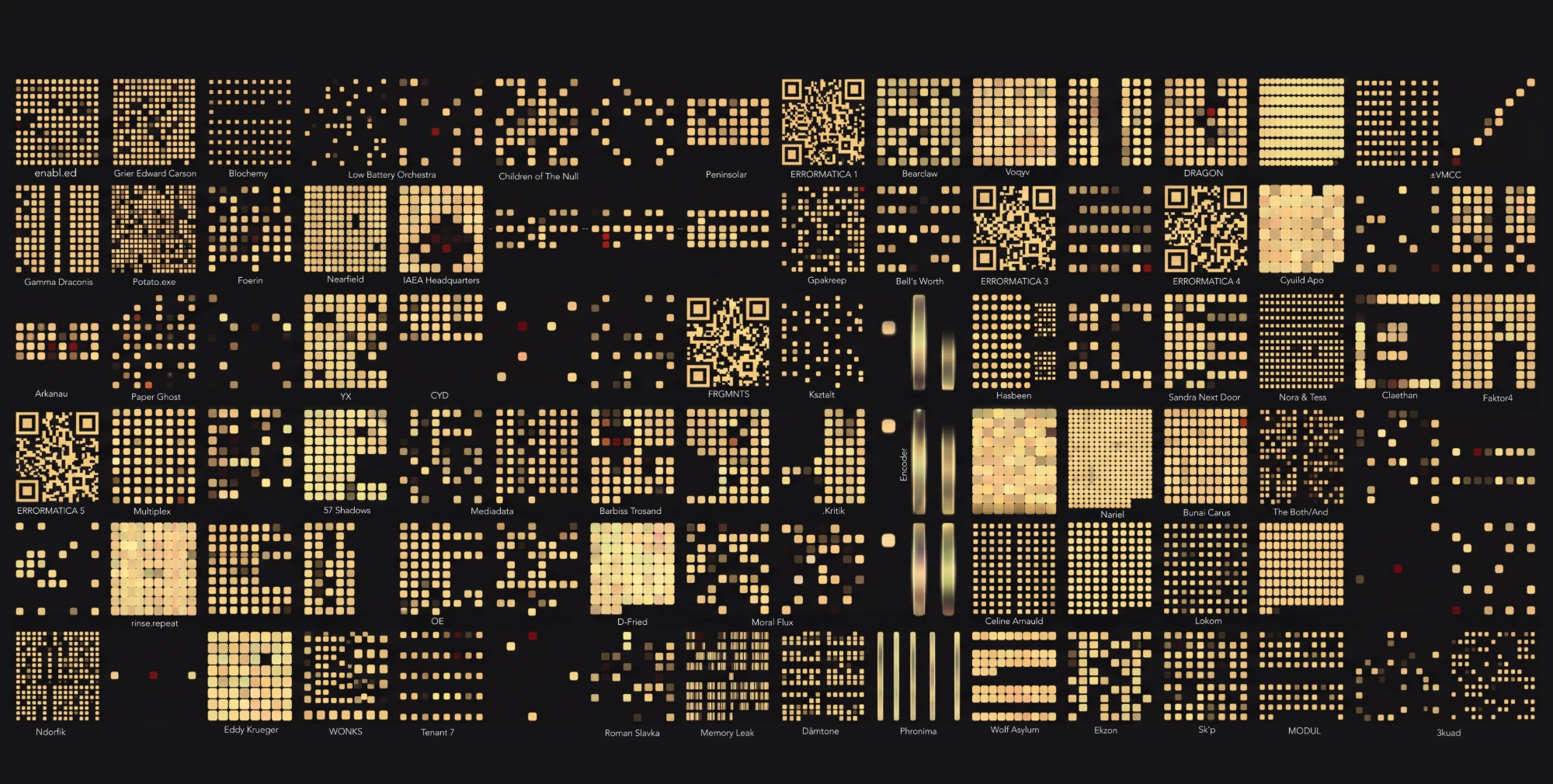
The roster, as it stood for ERR100.
Would I call all of that IDM? Some of it. Most people file us there, and I've said it myself. But we think about it a particular way. The error isn't decoration on top of a track. It's the subject. The design, the release notes and the visual identity all start from the idea that a broken signal can be more honest than a clean one. Different starting point than "make intelligent dance music," and I think it's why Clean Error doesn't sound like a 2001 revival even when the drums would sit fine on a Toytronic record.
The upkeep is real
People see the releases. They don't see the work around each one. Artwork, mastering coordination, metadata, credits, release copy, newsletters, social posts, artist communication, the Bandcamp page, the website. For ERR100, every vinyl copy received, inspected, numbered and sealed by hand in Atlanta. Every release is a small project. A hundred of them is a career.
That's why I don't open the floodgates. Clean Error doesn't run an open demo pool in the usual sense. I'd rather lead people toward understanding what we do than ask them to throw files at an inbox. Most of the roster comes from me scouting, signing people I've been talking to, or reaching out to people whose sound fits the Clean Error aesthetic. Potato.exe was an exception, and it was one because it fit. Toytronic's story tells me what happens when a label's yes outgrows the people who have to carry it out.
What changed in my own music
enabl.ed has been different things over the years. The Errorbalm volumes, Broken Flow, the Memory Leak x enabl.ed collaboration, and now IDM(r)ot. Recently I changed DAWs, which sounds like a footnote and isn't. A new environment breaks your habits. The shortcuts your hands knew stop working, and you make decisions you'd have skipped before.
The bigger shift is philosophical. I make music the way the label operates now. Error as a starting point, not an effect at the end of the chain. Fewer finished-sounding loops, more processes I can push until something gives. Running a label changed how I hear my own tracks. Some days that's a gift.
Where to find them now
What I'm taking from all of this
I don't have a five-point plan. I have a few things I'm holding onto.
Keep the context, not just the audio. Broken Fader Cartel's music survived and its story barely did. Underscan's best record lives on the artist's page now, not the label's. Every Clean Error release should carry its credits, date, catalog number, artwork credit and release text somewhere we control, so nobody has to rebuild us from fragments in twenty years.
Don't rest the whole thing on someone else's floor. Hefty lost its home distribution in one night. We control our store and our pressing pipeline now, and that's not an accident.
A quiet season isn't a death. A month or a year without a release shouldn't mean the label is over. Tigerbeat6 and BFC went quiet without saying so, and silence got read as an ending. If Clean Error slows down, I'll say it out loud.
Bridge the generations on purpose. Planet Mu's thirtieth did it on one tracklist. ERR100 tried something like it by turning the archive into an instrument.
And the one that's hardest to write down. The labels that disappeared didn't fail. Rephlex, Merck, Toytronic and Hefty made records people are still reissuing, reviewing and playing on NTS decades later. The institutions ended and the music kept going without them. Which makes me wonder whether the point of a label was ever to last forever, or to stand there long enough, with enough taste, that the right records got made.
One hundred and five catalog numbers in, I'm still standing there.
Further reading and listening
- Igloo Magazine: MERCK Records, first public statement
- Bandcamp Daily: A Look Back at Rephlex Records
- Wax Poetics: Aphex Twin, Rephlex Records and Squarepusher
- Dancing Astronaut: Aphex Twin shuts down Rephlex
- Chicagoist: The Interview, John Hughes III, Hefty Records (2006)
- Stop Smiling: Label Oral Histories, Hefty
- Igloo Magazine: Scanner, Lost Without Light (Underscan 10")
- Lapsus Records (Toytronic and Sending Orbs reissues)
- Sound On Sound: Kid 606, Cex and the Tigerbeat6 label
- Cokemachineglow: Kid606 interview, 2009
- Cafébabel: Warp's Steve Beckett interview
- Planet Mu 30
- Deezer: AI music passes 50% of daily uploads
- Clean Error Records on Bandcamp · ERR100: F A I L U R E