ERR100: Grier Edward Carson’s F A I L U R E | Interview
Ninety-Nine Errors and a FAILURE
Clean Error Records reaches its 100th release. Grier Edward Carson takes the archive apart and builds two new works out of the pieces.
One hundred.
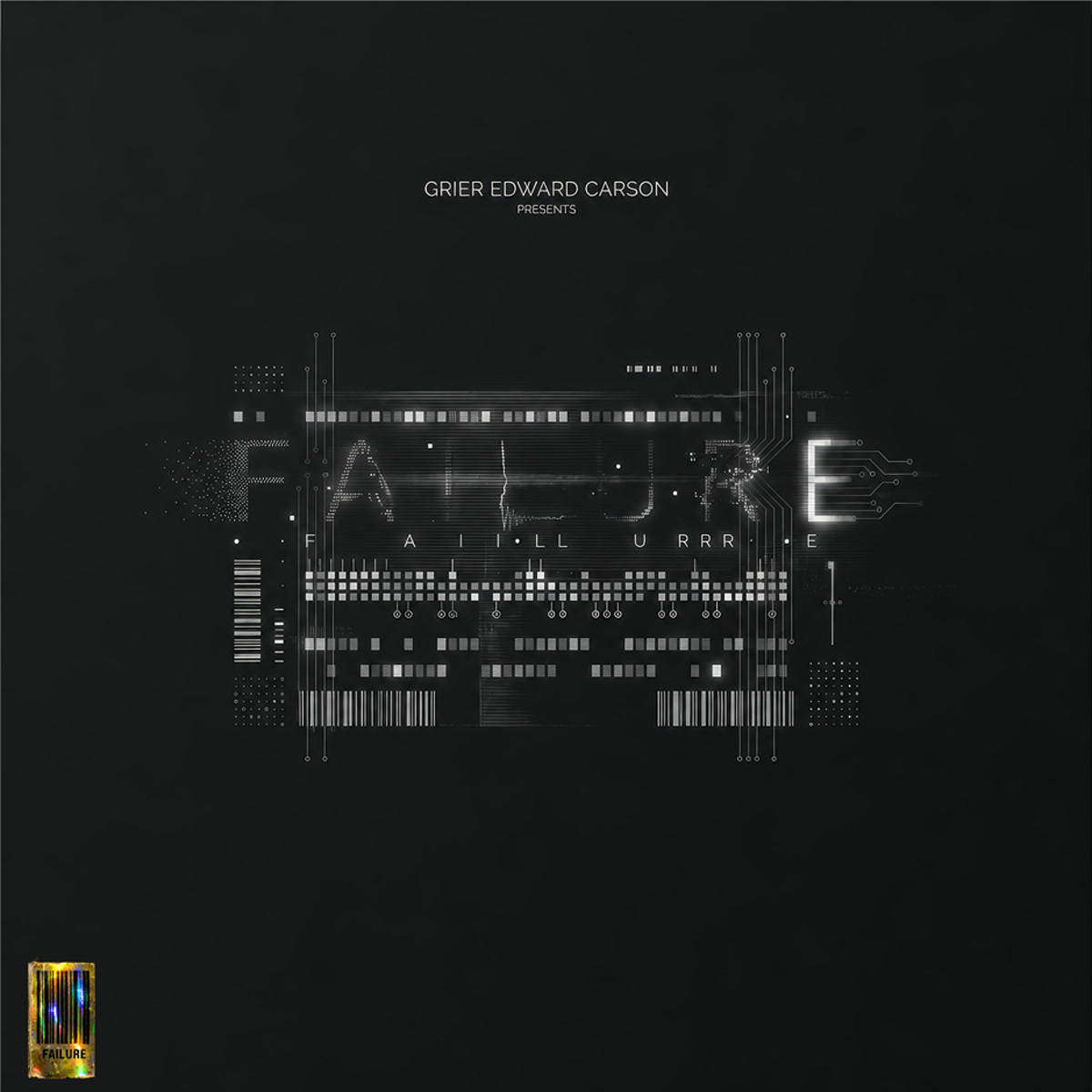
I've typed that number a lot over the past few weeks and it still reads strange. When Clean Error started in 2013 I wasn't planning for a catalog that went this far. I was thinking about the next release, then the one after it, and somewhere in all of that the numbers kept climbing. ERR100 is out now. The physical version lives as an artifact at failure.cleanmyerror.com, a numbered 12-inch, and the digital version is on Bandcamp if you just want to listen. Either way it's put together unlike anything else we've released. Grier Edward Carson took some of the finest material in our catalog and pulled it into his own language.
The idea came sideways. Around ERR083, actually, the first thing 2026 opened with. Tenant 7's Please Don't Be Afraid Anymore came out January 6th, their debut on the label, and I remember sitting with that catalog number and doing the math. Seventeen to go. Close enough that I couldn't keep putting off the question of what the hundredth was supposed to be.
ERR083, the release where the countdown to 100 started feeling real.
Why not a compilation
The obvious answer was a compilation. Ask everybody on the roster for a track, sequence it, call it a celebration. Labels do it all the time and some of those records are great. It wouldn't have done justice to this catalog though. A compilation presents a label's history as a stack of separate works sitting side by side. Thirteen years of Clean Error doesn't feel like a stack to me. It feels like one body of sound with recurring habits running through it, and I wanted the hundredth release to treat it that way.
So I asked Grier to use the archive itself as the instrument.
He doesn't write songs. He builds objects out of sound.
Grier approaches recorded sound differently than most electronic musicians I know. Most people start with an idea that eventually turns into a track: a melody, a drum pattern, a patch, an atmosphere they're chasing. With Grier the recording is the raw material. A sliver of percussion. A burst of noise. A small melodic gesture lifted out of some other composition entirely. He takes those and starts testing what they can do once they're cut loose from where they came from.
What happens when a recognizable phrase gets shrunk to a fraction of its length? Can a recording lose its identity and turn into something else?
The glitches in his work aren't accidents. A sudden interruption carries as much intent as a melodic transition, and a fraction of a second can hold the same structural weight as a whole phrase. That's why I hesitate to call what he does glitch music, even though glitch is usually what reaches your ears. It's closer to sound architecture. Something built to be examined.
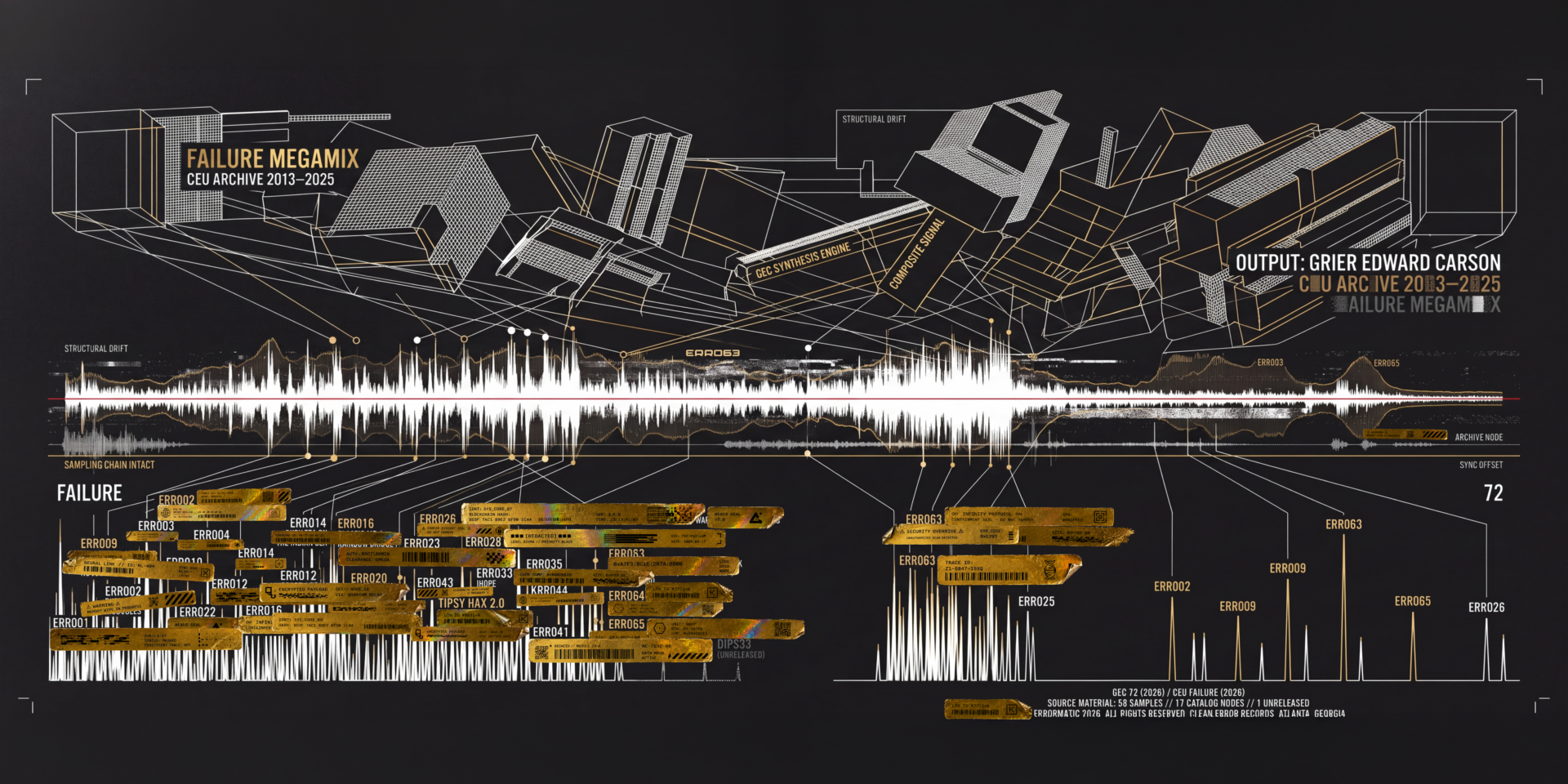
He once described his process to me as making hundreds of tiny megamixes and then connecting them into one larger piece. I keep coming back to that. Think about what a DJ does across a set, finding relationships between records, managing transitions, pacing the whole thing. Now shrink that operation down to fragments a few hundred milliseconds long. The fragments become miniature compositions, those stack into passages, and the passages eventually become one continuous work.
A simplified view of the process Grier described. It's a conceptual sketch, not a claim about the specific software or edits he uses.
Parmegiani, Oswald and two cassette decks
When Grier talks about influences, three names keep surfacing: Bernard Parmegiani, John Oswald and John Wall. Parmegiani trained under Pierre Schaeffer in 1959 and spent decades at the GRM in Paris turning captured sound into electroacoustic pieces that make you second-guess what you're hearing. De Natura Sonorum from 1975 is the one everyone points to. Headphones for that one.
Bernard Parmegiani, De Natura Sonorum (1975).
Oswald is the other side of the coin. He coined the word plunderphonics in a 1985 essay, "Plunderphonics, or Audio Piracy as a Compositional Prerogative," and then went and did exactly that, cutting famous records into new pieces. His Plunderphonic CD was pulled from distribution in December 1989 after the Canadian recording industry and CBS, acting for Michael Jackson, came after it. "Dab," his rework of "Bad," is the one most people know.
John Oswald, "Dab" (1988), from the official plunderphonics channel.
John Wall sits in that lineage of dense digital collage where the edit points get so small you stop hearing them as edits. Grier lives somewhere between the three. The physicality of the source recording, the transformation of existing records, and an almost obsessive attention to microscopic detail. The part that makes it his, though, is a lot more ordinary.
Mixtapes.
He grew up making them in the eighties and nineties, looping his favorite passages from rap records across dual cassette decks when he was ten or eleven. Public Enemy's It Takes a Nation of Millions to Hold Us Back pushed him further in. That tracks. The Bomb Squad built that record out of layered samples so dense that a few years later clearing that many sources had become too expensive for anyone to attempt. He still makes mixes, mostly for himself. Hip hop, new wave, piano music, classical.
He also grew up at the piano, and at some point those looped fragments started acting like notes on a keyboard in his head. Counterpoint crept into the mixtapes. Follow that far enough and you end up where he is now. The abstract work didn't come from wanting to make something difficult on purpose. It came from a lifelong habit of arranging and connecting recordings, pushed past the point where most people stop.
Two sides, one body of material
ERR100 is two pieces, roughly twelve and a half minutes each, one per side.
On FAILURE you meet the source material in a form you can still partly recognize. Grier builds new transitions and connections between the original Clean Error recordings but leaves their faces visible. On 72 the same selected material becomes something else. The original identities get harder to place, and they turn up as parts of a structure that has nothing to do with where they started.
The way I hear it, those are two states of the same material. One lets you taste the ingredients. The other shows you what the ingredients turned into. Neither has to come first. Put on 72, flip the record, and catch some of the relationships that made it possible. Or start with FAILURE and listen for the recognizable bits dissolving on the other side. Grier pushed back on how I framed this in our interview, and his answer is better than mine, so I'll let him have it below.
One clarification, since a few people have asked. ERR100 draws from selected recordings across the catalog, not every single release. The selection is part of the authorship.
Stream or download ERR100 on Bandcamp.
About the word
The title isn't a verdict on anybody's music. Nobody failed here, and Grier isn't correcting anyone.
What interests me is what happens when a system stops doing the job it was built for. A recording was made to work as a complete piece. Grier takes a sliver of it and hands it a different job. Its structure gets interrupted and its identity gets displaced, and its relationship to every other sound in the room gets rewritten. In conventional terms you'd call that a breakdown. Artistically it's where the new thing comes from. The original context comes apart and the sound picks up another possibility on its way out.
That's been the label's position on error since the beginning, more or less. Grier just works at a resolution most of us don't.
An object you can hold
Grier has told me more than once that he thinks of his compositions as objects rather than processes or performances. He said his music yearns for a physical form. Vinyl was decided the moment he said that.
A record has edges. Two sides, a fixed running time, a start and an end. You choose which side goes first and you physically turn the thing over to hear the other. Two related works living inside one artifact, and the twelve-minute durations sit in the format almost too neatly.
ERR100 is pressed as a 12-inch LP limited to 30 numbered copies. Each one ships with a visual booklet documenting the catalog, a hologram seal hand-numbered 01 to 30, and a Bandcamp download code. There's no warehouse and no distributor. Every copy is pressed to order, inspected, numbered and sealed here in Atlanta, then shipped from us to you. It's $70 with US shipping included, and the digital album is $5 on Bandcamp.
Why Grier
There's a personal side to this too. Grier has been connected to Clean Error since around 2013. He's watched the label change shape, put his own numbered works into the catalog, and stuck around through all of it. He's also told me plenty of times that he isn't sure there's an audience for what he makes. He keeps composing anyway. New source material, refined processes, more numbered pieces.
From everything he's described to me, none of it runs on gigs or engagement or the usual ways people measure whether music is working. He makes it because composing is the point. A label built around IDM, glitch and unconventional electronic music needs room for artists like that, people willing to make something intricate and hard to file because there's an artistic reason to. Grier is that part of who we are.
There's a difference between using experimental techniques and thinking experimentally. Anyone can grab a glitch plugin, chop some drums, run it all through distortion and end up with something that sounds experimental. Grier is asking what composition even is. What counts as original. Whether a fragment keeps any memory of its source, and when rearranging turns into authorship. Whether two works built from identical material can come out with completely different identities, and whether the listener needs any of those answers to get something out of the record.
He didn't remix Clean Error's history. He built a new compositional relationship with it. I had questions about how, so I asked him.
ERR100: FAILURE | An Interview with Grier Edward Carson
The source material is always present, but its function changes as you work more closely with it. The moment of transformation is actually a mystery to me. I have no idea when I’ve crossed over from referential sampling to a whole new original piece of music. It just happens - and when it does, I know it’s worth continuing. Sometimes it doesn’t happen, and then I’m just sampling for the sake of it, which is fun and can lead to other things but isn’t the ultimate goal. It has something to do with when the source material no longer drives the work but instead starts to serve the work. Then the material becomes just a set of sounds without any history.
FAILURE and 72 are definitely two different works. When I make a megamix like FAILURE, I’m usually highlighting something about the source material that I like. It’s done with respect for the original material and, by extension, the artist. It’s a celebration of whatever music or artist or genre I’m working with. But I’m not really thinking of it as an original work. I’ve never released any mixtapes before because I usually just make them for myself. In contrast, with the numbered pieces, I’m using source material to create something new. The approach and result are both very different. I do think of the numbered pieces as original compositions, regardless of how much source material remains recognizable. If you listen to FAILURE before you listen to 72, you’ll probably hear the difference.
Hip hop and mixtape culture have had an enormous influence on me. The technology makes the music concrete, an object you can manipulate. These are of course ideas that have been around for like a century, very 20th century stuff, but I was unaware of anything happening in serious music because I was a little too young, maybe 10 or 11. But I was obsessed with rap music, and I would take passages from my favorite songs and loop the parts I loved. I was getting pretty skilled at doing that with dual cassette decks. Public Enemy’s Nation of Millions came out and it inspired me to keep going with that kind of tinkering. I also grew up playing the piano, and at some point I started thinking of these looped fragments like notes on the keyboard. Counterpoint-thinking started to influence how I made mix tapes. It was probably inevitable that I would get into more intricate cutting and arranging of sampled material, certainly once DAWs came on the scene. But that’s a whole other conversation in terms of the relationship between composition and technology.
There’s a strange dichotomy between creativity and control that is both fascinating and frustrating. I’m definitely driven by a sense of control over the material and what I hope to do with it. It’s the point of origin for all of my music. That might seem odd given how my music sounds, but there’s intent behind everything that’s happening in my music. However, it would be foolish to dismiss mistakes, errors, or glitches that occur in the process. I feel that music has benefited greatly by learning from the plastic arts and from painting in particular. The material itself might be trying to tell you something, and it’s wise to allow space for that to influence your decision-making. For me, the balance between deliberate action and failure-led exploration is a matter of instinct.
It depends on whether I’m working on a mixtape or an original composition. With an original composition, I don’t really care about the identity of the artist I’m sampling, and I certainly don’t feel any responsibility for it. I’m only interested in the material itself and how it might relate to other material I plan to use. There are sometimes deliberate contextual references between samples within an original composition, like in 53.2 for instance, which you could call “meta-musical”. But I’m more focused on the sonic potential of a sample than the artist, genre, or whatever. With mixtapes, the identity of the sampled artist plays a central role both in terms of preserving the integrity of the original work and in weaving complimentary artists and tracks together. Even with large scale mixtapes that run for hours and involve very detailed edits, I’m still intentionally preserving the integrity of the original sample and trying to do justice to my understanding of that artist’s work. In my mind, I don’t ever truly abandon the original artist while working on the mix, but I do set set it aside when I go digging for the right sound or section to sample, and it’s then that I have to forget “who” I’m sampling in order to listen for what might be possible. But I always pull the artist’s identity (or my understanding of them anyway) back into it when I start arranging things seriously. For example, the last few tracks sampled in FAILURE which effectively close the mix were chosen not just for their rhythm, tonality, and overall character but also for their artistic identities. There’s meaning for me in the placement of those artists and their tracks.
Sound is the most important thing. Sound stretched and scattered across the canvas is the form. Everything else is secondary. That’s not to say that musical forms aren’t useful, but they do tend to box us in, contribute to a narrow way of hearing and thinking about music. In my own music, the form usually emerges on its own. It’s a privileged approach that obscurity affords, and it’s self-serving and impractical. But that’s by choice. I’m interested in how the music works within a listening framework, whether that’s a 30 min journey through headphones or a 5 sec blast from the window of a passing car. I’m only interested in form insofar as how well the music succeeds within whatever listening frameworks we have at our disposal. That’s something I’ve always loved about classical music. The framework is a set of physics-based rules filtered through a very limited sonic palette and restricted to real time performance. It turns out to be incredibly elastic. I think of headphone music the same way. But that’s just how I listen. I don’t have any hopes or expectations for the listener. Whatever the emotional impact, intelligibility, listening framework - that’s all up to the listener. You could loop 2 seconds of my music and that would be fine, or you could play all of my music on repeat or as background noise and that would be equally fine. As far as the potential value of demanding music today, I really don’t know. Right now, music is an ephemeral commodity, so attention-seeking is the name of the game. Forms and norms are more or less required for that, and because that’s not my goal it’s difficult for me to gauge what other people like or don’t like. The majority of my music is densely-arranged and without many relatable musical idioms and is therefore unlikely to work in a short-attention span environment. Paradoxically, it’s built on the idea that listening to short bursts and passages is just as rewarding as listening to the entire work from start to finish. So in that sense, short attention spans don’t present a problem for me. In my experience, anything you can fully-understand after hearing just once or twice isn’t very interesting. The question is ultimately a historical one about how our musical minds may work in the future, and we don’t know the answer to that yet.
This project definitely changed my perception of the label. I’ve been fortunate to work with James and Clean Error for the past 13 years and have been familiar with the overall aesthetic of the label for most of that time. But I haven’t followed every release closely and certainly didn’t know all of the artists when I started work on this project, and so most of the catalog was new to me. There are a few “categories” of sounds that a number of CE artists use, and that made the preparation work pretty straightforward. And it was satisfying to familiarize myself with these artists and to try to understand what they were doing with their music. Once I did, it was fairly easy to choose what to sample and how to arrange the mix. The challenge was having to restrict what I used in order to fit within the agreed-upon time limit. There was a lot more I wanted to do and would like to do with the CE catalog.
It depends on what type of world we’re living in and the function of art within it. Today, we understand art in a linear way through history and ideology. It’s possible that future listeners will use music in a radically different way and exist in a far more complex sensory environment in which things have meaning and resonance we can’t possibly understand. That’s already happened recently, and more than just a few times. But if apples are still apples, I’d like to think that the FAILURE megamix would serve to honor the CE legacy as a sort of survey of its catalog - and that 72 would stand alone as another GEC work, to be heard or cut up or tossed aside like any other.
Grier Carson
"To be heard or cut up or tossed aside like any other." I've read that line more times than I'd like to admit. A hundred releases in, the record that marks the number belongs to the archive and refuses to be precious about it at the same time.
Thirty copies. Two sides. Start on either one.