Hasbeen on Happy < Damage: Broken Drums, Stubborn Melodies and the Clean Error Sound
Hasbeen talk Happy < Damage (ERR105) with label head enabl.ed: broken drums, melody under pressure, and how a HAVOC INTVL sequel became its own album.
- Reading time
- 14 MIN
- Logged
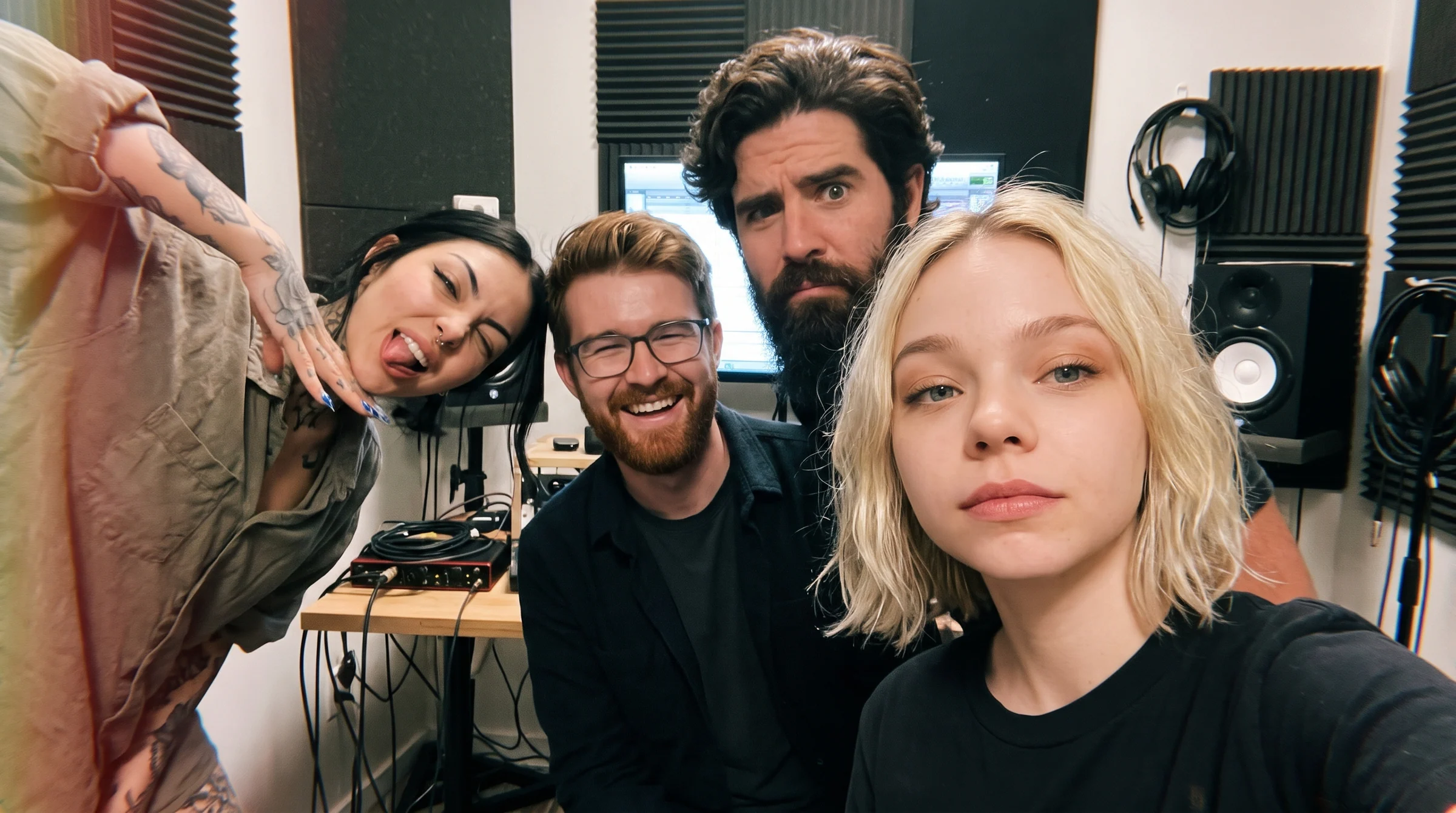
I know Hasbeen from both sides of the desk. As Clean Error I put out their records. As enabl.ed I remixed "bunkerData" for Bunker Symphonies II and made music with Nora and Tess for the FRGMNT collab series. I'm too close to this group to be objective, so I won't pretend otherwise. Their new album Happy < Damage, released November 5 as ERR105, is the strongest thing they've handed me. Ten tracks, about 39 minutes.
The drums hit harder and break more often than on anything they've made. And as the damage piles up, more feeling comes through. Underneath all that stutter there are melodies that sound like someone humming to keep themselves calm. Halfway through the Bandcamp listening party, Anthony (MODUL, one half of AXON) called it the epitome of the Clean Error sound.
ERR105: Hasbeen, Happy < Damage. Ten files, 39:09.
Four friends and a name that sounds like a eulogy
Hasbeen is Nora, Tess, Daniel and Jairo. Nora and Tess met in high school, picked up Daniel and Jairo in college, and the friendship slowly turned into a project. The demo that first reached me was tagged "unknown artist." I named them Hasbeen, which is a strange thing to call people who hadn't released a single track yet. A has-been is someone whose moment already passed. I liked giving that word to four people at the very start, and I like it more now, because every record since has been an argument against it. Through Port Rhombus I built the visual identity around the name, and I've built the concept behind every release since.

Their taste is all over the map, and you can hear it. The IDM lineage is the backbone, that whole history of brainy, broken electronic music from the 90s forward, but so are dance music, trance and the occasional mainstream pop record, mostly from Nora and Tess, who will defend a good pop hook to anyone. Tess goes deep on classical music, the more intricate the better. Daniel and Jairo lean toward the classic era of electronic music. What all four share is a love of speed. Daniel especially loves the hyper edited end of IDM, where the programming tips over into madness and the drums stop making sense, which was always the appeal.
They also have full lives outside the group. Nora plays in another underground group. She and Tess both put a lot of themselves into their own businesses, and they're roommates, so their place is where everyone ends up when the guys come over. Daniel and Jairo have their own work and their own musical outlets. Life gets in the way, the way it does for everybody, and actually finishing things has been hard at times. When they do lock in, it sounds like four people who've been saving it up.
Nora and Tess also release as a duo, Chaos Pool and Miras Loop, and the group has worked with rinse.repeat, Moral Flux and Tenant7, who made "Thread4" with them for the FRGMNT series. They also brought their friend Sandra to me. She'll have her own release on Clean Error soon, which is how a label like this grows: one friend at a time.
ERR090: Nora & Tess, Miras Loop. Igloo covered it in May.
From the bunkers to the breaking point
The debut, Bunker Symphonies (ERR053, June 2024), already had the DNA. Metallic percussion chopped into tiny pieces, soft pads slipping in between, and bonus cuts like "Mynsc" that people still bring up. Cris Quizzik heard Autechre and Plaid in it for Igloo, and noticed it got denser and harder to predict the longer you sat with it. Everything he pointed at is still there today. They've just pushed it much further.
ERR053: where it started.
A Fractured Life (ERR056) has a backstory most people don't know. It's the first demo they ever sent me, minus four tracks and a few re-edits. Jairo has never liked it. He calls it a practice album, "us messing around." I wanted it out anyway. A practice album shows you how someone practices, and I thought people should hear those instincts before they got sharpened.
The world around the music is my side of the work, same as with every Clean Error release. For Bunker Symphonies II (ERR066, March 2025) I imagined stacked bunkers under the city, each with a bed, a screen and recycled air, and looped broadcasts keeping everyone calm. Hasbeen became the ones collecting the music the machines couldn't erase. Pietro Da Sacco picked up on the ambient turn for Igloo.
HAVOC INTVL (ERR070, July 2025) started with a question: what if their music was the process running inside a broken game? I built it as a fictional mixed reality module. A grid touchscreen, synced headsets, modules called THREADSLICER, FOAM_CHANNEL and CRASHMOTION, and a player trying to catch beat fragments before the session collapses. You can't save. You can't replay. Every moment of stability is borrowed. Their drums already behaved that way, so the game was mostly me writing down what I was hearing. Igloo covered that one too.
The Hasbeen file so far.
The album that was almost HAVOC INTVL II
When the new material showed up, they were calling it Havoc Interval 2. I understood why. The same restless drums were there. But listening late at night on headphones, it sounded like the aftermath of HAVOC. The game was over, and somebody had to live in what was left.
The word that kept coming back to me was damage, in the way it actually works on people. You carry it. You build around it. Some days you joke about it. These tracks move like that. The drums break, get patched, then break again in a slightly different spot, and the melodies keep walking through all of it like they've stopped noticing the cracks. Some passages are almost cheerful, and I found those harder to sit with than anything bleak would have been.
It took about nine months. They sent more than ten tracks, and I cut several, including a couple of the most technically impressive things they've ever made. Those were hard calls. An album is a chain of moments where each one has to earn the next, and those tracks pulled the story sideways. Cutting good work is the part of this job nobody sees. I'd take the group being annoyed with me for a week over a record that sags in the middle.
What it sounds like
A kick lands as a kick, then a bar later it's been smeared into texture, and you start following the rhythm by the spaces it leaves behind. Memory works the same way. You lose the details and keep the shape. Once you listen for it, the precision underneath is obvious, and it's what makes the chaos feel lived in.
The melodies carry the emotional weight. They hold a line while everything around them gives way, and sometimes they get pulled under too. The titles read like a diary kept on a failing hard drive. "life.error" opens it. "friend.deleted" and "social.lag" are about how people drift apart through screens. "happy.damage" sits right in the middle, and "hµman.slop" closes it. With AI music flooding every platform this year, that last title lands hard. They end an album about corrupted systems by asking what we've turned into.
The title is a comparison operator, and the Bandcamp page plays it like code: the statement evaluates true and gets stuck in a loop. Happiness is less than the damage, permanently. On paper that's bleak. Then you see the artwork's corrupted smiley face, surface intact, structure compromised, still grinning. A person can look fine while drowning. A machine can show a green status light while its core is locked. A track can sound playful while it's built from shrapnel. Clean Error was built on leaving the errors in. Hasbeen put that idea in the title and made it do math.
In conversation with Hasbeen
I asked each of them two questions. The drums, the melodies, the tracks that got cut, the title, and where they go from here.
Q1 · NoraWhen you started on what became Happy < Damage, was it always going to be a full album, or did you see it as a continuation of HAVOC INTVL? When did it turn into something different?

Um, honestly I think we were still kind of inside HAVOC when this started. That one had such a specific feeling, like everything's about to break and you're trying to hold it together for one more second. Some of that just... stayed. We never sat down and decided to make it heavier. It's just where we were.
But I remember the melodies starting to feel more important. Like, there'd be this complete mess happening and then something really pretty underneath it, and I'd get kind of quiet listening back. That didn't happen with HAVOC. So at some point it stopped feeling like a sequel. HAVOC was about trying to survive the system. This one is more like... after. Living with what it did to you. I don't know. I wanted it to be its own thing.
Q2 · DanielThe percussion is way more aggressive and fragmented than your earlier releases. What changed in your drum programming, and how do you know when a rhythmic experiment is useful and not just complicated?

You can stack hundreds of edits, irrational subdivisions, ratchets nested inside ratchets, and end up with something technically dense and emotionally inert. Complexity is cheap now. Software will generate it for you all day. What I care about is whether a pattern seems to have a will of its own.
On this record I got fixated on the threshold where a sound stops being itself. You take a snare, resample it, granulate it, feed it to something that misreads it, and somewhere along the way it sheds its identity. It's an event with a texture and a temperament now, and the question becomes how it negotiates with everything around it. The listener still needs an anchor, though, even one small figure that repeats. Without a constant, variation has nothing to push against and it all flattens into noise. Hold one element still and everything else suddenly sounds precarious. And the most painful part is deleting an edit you spent four hours on because the track breathes better without it. You learn to grieve those fast.
Q3 · TessFor all the rhythm and sound design, Hasbeen has always had a strong melodic identity. Coming from violin, do you approach melody differently in experimental electronic music? How did that develop on this album?

I don't really separate melody from sound design as much as people expect. Sometimes a sound is interesting because of how it moves, not the notes. With violin you're always thinking about expression, even on a simple phrase. Timing, pressure, the movement between notes, how something fades. Electronic music gives you other ways into that. You can make a melody unstable by shifting its timing. You can take something warm and familiar and drop it into a really uncomfortable environment.
I don't think a beautiful melody needs a beautiful sound around it. Sometimes the contrast is what makes it emotional. On this album we let certain melodic ideas survive inside arrangements that kept changing, almost like something familiar trying to stay recognizable. I also like when a melody doesn't fully resolve. There's something very human about leaving a feeling unfinished.
Q4 · JairoThe album took about nine months and went through a lot of changes before the final ten were picked. What does that look like with four people, and how hard is it to let go of material that doesn't make it?
So yeah, I mean... four people means a track gets finished four times. Nora thinks it's done, Daniel hears one thing he wants to change, and suddenly we're three versions deep. Then somebody goes back to version one like, wait, that was better. So you end up with this huge pile of stuff.
I've kind of made peace with that, though. If you zoom out, nine months on one record sounds like forever, but next to how long the four of us have known each other it's nothing. It's one chapter. And the tracks that got cut, I think of them like sketches in the margins. They showed us the edges of the album, and that's how we found the middle. Having James in there helped too. When you're inside a track you get attached to a sound you spent a whole weekend on, and he's just listening for whether it moves things forward. Sometimes he was right. I mean... we probably didn't say that at the time.
Q5 · NoraThe title puts happiness and destruction against each other. When you think about the album's emotional identity, is it dark, playful, or somewhere in between?
Somewhere in between, I think? To me damage can feel joyful sometimes. A rhythm can be completely falling apart and the way it moves still makes you smile. And then a really simple melody can be way more uncomfortable than something loud and distorted. That's weird, but it's true.
The title makes me think about what something looks like versus what's going on inside it. You can have a cheerful face and feel totally overwhelmed. A song can sound playful while everything under it is unstable. Um, I guess we live with a lot of contradictions, and music gets to leave them sitting there. The listener decides what they mean.
Q6 · DanielThe visuals grew into fictional damage processing machines, DMGER v1.3 and the DMG NOD3 concept, and some of that is turning into real interactive audio interfaces. How do you feel about your music becoming something people can manipulate instead of just listen to?
It feels like a natural extension, because so much of how we work is already interactive. You're constantly perturbing parameters and watching how a system responds when it misbehaves. The listener only ever hears the residue of that process. An interface could expose some of the behavior underneath. It wouldn't need to replicate our sessions, that would be absurdly convoluted. A reduced system where you can feel causality is enough. Push the processing and a rhythm fractures. Lean on one control and the whole thing destabilizes. Maybe the machine answers with something you didn't ask for.
The interesting part is consequence. A fully predictable system is just an effect. A system with a bit of temperament becomes a place you explore. James built that world around the record, and it's a fun thought that people could reach in and damage it themselves.
Q7 · TessThere's a lot of human experience hidden in technical language in the titles: friend.deleted, social.lag, panic.cache, hµman.slop. Are those tied to real experiences, or do you prefer the listener building their own meaning?
I prefer when a title suggests something without explaining everything. Something like "friend.deleted" means different things depending on who's listening. One person thinks about losing a friendship. Another thinks about how disposable relationships can feel online. Someone else connects it to something totally different. I like that the words have a technical meaning but point at something emotional.
That's what makes electronic music interesting to me. The tools can seem really mechanical, but the people using them still bring their own experiences. A computer doesn't remove that, it gives you another way to express it. Titles change how you hear a track, too. You listen without knowing the name and imagine one thing, then you read the title and suddenly hear something else.
Q8 · JairoAt the listening party Anthony (aka MODUL) called Happy < Damage the epitome of the Clean Error sound. Considering how much Hasbeen has changed since Bunker Symphonies, how would you describe the group's identity now, and where does it go next?
That was really nice to hear, honestly. I mean, we're just making what we're into. But I get why he'd hear it that way. The label has a sound because of all the people around it, and we've been around it for a while now, so yeah, some of that has rubbed off on how we think about music.
I try to keep it in perspective, though. Each record is basically a snapshot of where we were at that point in our lives. If the next one sounds exactly like this, we'd get bored. It might be quieter. It might be stranger, or barely have drums, or we get obsessed with something totally different. We don't need to know yet. Nobody ever decided Hasbeen had to sound one way forever. And hopefully nobody does.
The epitome, for now
Glitches are everywhere now. Every plugin store has a dozen ways to break a sound on purpose. What I listen for is whether the break carries weight: a rhythm that falls apart for a reason, a melody that gets to mean something while the ground moves under it. Hasbeen found their own way into that, and Anthony heard it happen in real time.
If the label outgrows that description, I'd like it to be because of them. Jairo's already talking about something quieter, stranger, maybe close to drumless. Meanwhile DMGER v1.3, the damage machine I sketched after long talks with Nora and Daniel, FLOW to CORRUPTION to REBUILD, is sitting in a folder on my drive. I open it every few days to see if it's ready to become something you can actually play.
Released November 5, 2026
Written and produced by Hasbeen
Mastered at error.node studios
Concept and design by Port Rhombus
Listen and buy on Bandcamp
More Hasbeen